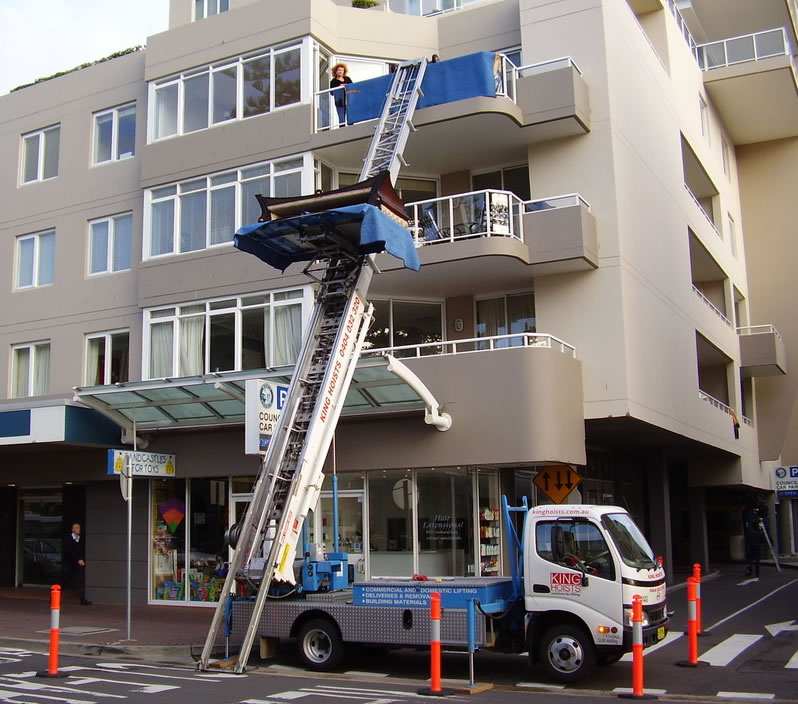
We lift 300 kg up to 33 metres (approximately 10 storeys), to your window or balcony. We operate in the
Sydney Metropolitan Area. The lift is ideal for whole removals, deliveries of large items such as sofas, building materials
and records. It has been used successfully to lift 7-metre lengths of roof sheeting up to a roof and 3.6-metre lengths of
plasterboard – though larger sheets of plasterboard would be possible with timber underlay.
The lift is used:
Where bulky items (e.g. sofas) are difficult or impossible to fit into a narrow stair well, a small lift or through narrow doors and where there is a window, or a balcony with a window, that is large enough, the items can be lifted or lowered on the outside of the building.
Using the lift is fast, safe and efficient, with considerable savings in labour. There is less handling as loads go directly from the street to the upper floor. It saves on the back-breaking work involved in lifting heavy or bulky or multiple loads up and down stairs.
A further advantage in lifting on the outside of the building is that less damage is done to the items being moved as well as to the internal corridors, stairwells and lifts.
In addition, larger sheets of building materials such as plasterboard and plywood can be passed up safely and efficiently. There is no need to order smaller sheets to fit through narrow doors, lifts and stair wells. This means additional savings in construction time as fewer joins are necessary.
There are health and safety advantages to working with the lift. Loads are lifted square-on rather than around awkward corners up stairs, resulting in fewer back injuries and less employee sick leave. The lift is a far safer way of moving furniture externally, particularly when compared with the practice of hoisting using straps or ropes. With the lift there is less pressure (and the pressure is inwards, not outwards) on the balcony railing and no need for persons to lean out over the railing – once the goods are at balcony level, the lift's platform slides over the top of the railing into the balcony area, making it very safe and easy to load and unload.
The following FAQs should answer most of your questions.
Where does King Hoists operate? We operate in the Sydney Metropolitan Area. We can, however, travel further afield should this be required.
What is the maximum height that can be reached? 33 metres if the truck is close to the building. Less if it is further away
from the building.
How many storeys is 33 metres? Ten or eleven storeys, depending on the height of each storey.
What is the maximum load? 300 kg
Where must the truck/lift be positioned?
The ladder and the balcony or window must be in a same vertical line. This is to
allow the top of the ladder to rest squarely on or against the balcony rail, or window sill, or wall just below the window sill.
In some cases an angled landing stage can be built to allow the top of the ladder to rest squarely despite the ladder being set
up slightly to one side. The distance between the wall and the base of the ladder must be no more than approximately 10 metres.
What is the furthest distance from the building that the truck/lift can be set up? Approximately 10 metres if going up to a higher floor; less if servicing a lower floor. The lift works better the closer it is to the vertical plane.
Can the furniture lift be used on sloping ground?
Yes, the ground has to be built up, for example with lengths of timber, so
that the truck/lift is level. In some cases this is not necessary when working with the ladder over the cab.
What are the dimensions of the platform when opened up flat? 2340 x 1420 mm. Wider loads can be carried depending on the
nature of the goods. For example, 3.6 m lengths of plasterboard can be carried without extra supports. Timber supports can be
used for larger sheets.
What are the internal dimensions of the platform with all four sides up? 1500 x 1000 mm.
What are the internal dimensions of the platform with the two side panels up? 1500 x 1420 mm.
Is it a crane? No, the head (top) of the ladder must be supported when working under load.
Overhead power lines and trees? There must be no obstacles overhead or to the sides of the truck. Even if it appears that the
lift could operate through a gap in trees or under power lines, it is important to remember that the lift needs room to manoeuvre
into that position. There must be a clearance of at least 3 metres between power lines and any part of the lift or its load.
How wide is the truck? 1880 mm.
How long is the truck? 6.15 metres.
How much space will the truck and lift take up once set up?
Sideways: the width of the truck plus room for the drop-down ladder, which depends on the angle of the ladder - a total
width of minimum 3.5 metres. If working high up or far from the building, the outrigger jacks on the working (building) side
must be fully extended, which adds another 750 mm.
What about narrow driveways? If the window or balcony is at the end of the driveway, the ladder can extend over the cab.
In which directions can the ladder be set up? To the right, to the left and over the cab (in the fore-and-aft line of the truck).
Can the lift carry persons? No, it is designed for goods/materials only.
My balcony does not look very strong. Will it be able to support the ladder? We have designed a prop especially for this purpose.
The prop can be used to brace the balcony railing or ladder against the foot of the sliding windows. The more vertical the ladder is,
the less pressure is exerted on the balcony.
Will wind affect the operation? Yes. Particularly for high lifts, wind is an issue and it may be necessary in some cases to postpone the lift. We endeavour to check the weather forecast when planning this type of lift.
Is a permit required? No permit is required if operating on private land. A crane permit or 'permit to stand plant' may be required when operating on public land, i.e. a footpath or the road. The great advantage of the truck/lift is that it does not normally obstruct traffic.
How can I be sure the lift can be used in my situation? By far the easiest way is to send us a couple of digital photos by e-mail to info@kinghoists.com.au together with your phone number. We can then call you to find out exactly which window or balcony is concerned and other details.